
Colorado HOA Rules for Short-Term Rentals
Short-term rentals (STRs) have gained popularity across Colorado as homeowners look to generate additional income by leasing their properties on platforms like Airbnb and Vrbo. However, homeowners’ associations (HOAs) often impose strict regulations on STRs to maintain community standards and property values. Understanding Colorado’s HOA rules for short-term rentals is essential for property owners to avoid fines, legal disputes, and potential litigation.
 Understanding HOA Authority Over Short-Term Rentals in Colorado
Homeowners’ associations in Colorado have significant authority over properties within their communities. HOAs operate under covenants, conditions, and restrictions (CC&Rs) that outline what property owners can and cannot do. These governing documents may regulate, restrict, or outright prohibit STRs to prevent increased noise, parking congestion, and high tenant turnover.
Under Colorado’s Common Interest Ownership Act (CCIOA) (C.R.S. § 38-33.3-101 et seq.), HOAs have broad powers to enforce regulations as long as they act within the boundaries of their governing documents and state law. Property owners must review their HOA’s bylaws, declarations, and rules to determine if short-term rentals are allowed, restricted, or banned.
HOA Restrictions on Short-Term Rentals
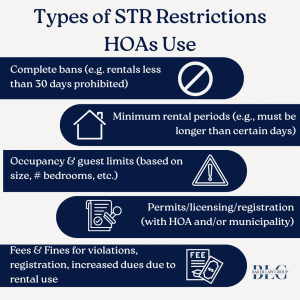
Complete Bans on STRs
Some Colorado HOAs explicitly prohibit short-term rentals, defining them as leases shorter than 30 days. Such bans are often implemented to maintain a residential atmosphere, prevent excessive foot traffic, and reduce potential disturbances.
Minimum Rental Period Requirements
Some HOAs enforce minimum rental period requirements, such as a 30-day minimum lease rule, rather than banning STRs entirely. This restriction ensures that rentals align more closely with traditional leasing rather than vacation-style stays.
Occupancy and Guest Restrictions
To prevent overcrowding and excessive wear and tear on community amenities, HOAs may set occupancy limits based on the number of bedrooms or square footage of the home. Additionally, some HOAs impose rules restricting the number of guests per rental period or limiting the number of rentals allowed per year.
Permits and Licensing Requirements
Even if an HOA allows short-term rentals, property owners may need to comply with local municipal requirements, such as obtaining a business license or short-term rental permit. Some HOAs require homeowners to register their rental properties with the association and provide proof of compliance with state and local laws.
HOA Fees and Fines for STR Violations
Many HOAs impose additional fees, assessments, or penalties for homeowners renting their properties as STRs. These may include:
- STR registration fees to cover administrative costs.
- Fines for unauthorized rentals can accumulate daily until the violation is corrected.
- Increased HOA dues for rental properties due to increased use of community facilities.
Legal Considerations for Colorado Property Owners
Colorado’s Right to Rent Laws
While Colorado property owners generally have the right to rent their homes, HOAs have legal authority to regulate STRs through enforceable covenants. 2021, Colorado passed HB21-1117, allowing local governments to regulate STRs through zoning and licensing laws. This means homeowners must comply with local ordinances even if an HOA permits short-term rentals.
Grandfathering Clauses
In some cases, property owners may have rented their homes as STRs before HOA restrictions were enacted. Certain HOAs include grandfather clauses that allow existing STR owners to continue operating under the old rules. However, these provisions vary by community and may require legal review.
Challenging HOA STR Bans
If a property owner disagrees with an HOA’s restrictions, they may attempt to challenge them through:
- Petitioning the HOA board for rule amendments.
- Gathering homeowner support for a vote on changing the bylaws.
- Legal action if the restrictions are improperly enacted or enforced.
Consulting a real estate attorney can help homeowners determine whether their HOA’s rules are legally enforceable and explore potential legal challenges.
Navigating Local and State STR Laws
In addition to HOA regulations, homeowners must navigate state and local laws governing short-term rentals. Many Colorado municipalities, including Denver, Boulder, and Colorado Springs, have enacted STR regulations that impact HOA-governed communities.
Denver STR Laws
- Property owners must obtain a Denver short-term rental license.
- STRs are only allowed in primary residences.
- Hosts must comply with lodging tax and zoning requirements.
Boulder STR Laws
- STRs are divided into principal residence rentals and investment properties.
- Licensing and occupancy rules vary based on property type.
- Some neighborhoods have HOA bans that supersede city regulations.
Colorado Springs STR Laws
- Zoning laws dictate where STRs can operate.
- Permit applications require neighbor notification.
- Fines are imposed for operating without a permit.
Understanding these municipal rules is crucial for homeowners operating STRs within HOA communities.
Best Practices for HOA Homeowners Engaging in STRs
For homeowners looking to legally operate a short-term rental while staying compliant with HOA rules, consider these best practices:
- Review HOA CC&Rs thoroughly before listing a property as an STR.
- Obtain necessary permits and licenses in compliance with local regulations.
- Communicate with HOA leadership to clarify any ambiguities in rental policies.
- Respect community standards by enforcing guest behavior rules and limiting noise disturbances.
- Maintain proper insurance coverage to protect against liability concerns.
Contact a Denver Real Estate Lawyer
Navigating Colorado’s complex HOA regulations and municipal STR laws can be challenging. If you’re a homeowner facing disputes with your HOA over short-term rentals or need legal guidance to ensure compliance, Baker Law Group is here to help. Our experienced real estate lawyers can clarify your rights, assist with HOA negotiations, and defend against unjust enforcement actions.
Contact Baker Law Group today to schedule a consultation with a knowledgeable Denver real estate lawyer and safeguard your property rights.