Criminal charges in Colorado can be confusing—especially when terms like “menacing” and “assault” sound similar but carry very different consequences. Knowing the difference between these two offenses matters because it can change how your case is handled, what penalties you face, and the strategy your defense attorney uses. At Baker Law Group, PLLC, our attorneys explain the law clearly so you understand precisely what’s at stake and what steps to take next.
Defining Menacing Under Colorado Law
Menacing occurs when a person uses threats or actions to make someone fear imminent serious bodily injury. The danger does not have to result in physical contact—simply putting another person in fear is enough for a charge. Colorado Revised Statutes §18-3-206 defines menacing as knowingly placing or attempting to place another in fear of imminent serious bodily injury through threat or physical action.
Menacing can be charged as a misdemeanor or a felony, depending on the circumstances. If a weapon is involved or the defendant claims to have a weapon, the charge escalates to felony menacing. For example, pointing a gun at someone, even if it isn’t loaded, can lead to a felony charge because of the perceived danger.
What Constitutes Assault in Colorado Springs
Assault, by contrast, involves physical injury. Colorado law recognizes three degrees of assault, each with varying levels of severity and intent.
- First-degree assault involves intentionally causing serious bodily injury with a deadly weapon.
- Second-degree assault typically involves intentional injury without serious harm, or reckless use of a deadly weapon.
- Third-degree assault is a misdemeanor and occurs when someone knowingly or recklessly causes bodily injury, even minor harm, to another person.
In other words, assault requires actual contact and injury, while menacing centers around fear and threats. This distinction between menacing vs assault is critical in determining how a case is prosecuted and defended.
Comparing Menacing vs Assault Charges
When comparing menacing vs assault, the key difference lies in physical contact. Menacing is based on intent and fear; assault requires injury. However, both can occur during the same incident—such as when someone threatens another person and follows through with physical harm.
Both charges can lead to jail time, fines, and long-term effects on employment and background checks. Felony-level offenses, in particular, can result in years of imprisonment and the permanent loss of firearm rights. Courts in Colorado Springs treat both offenses seriously, and prosecutors often pursue the maximum penalty allowed under the law.
Penalties for Menacing vs Assault in Colorado
Penalties depend on the charge level and circumstances: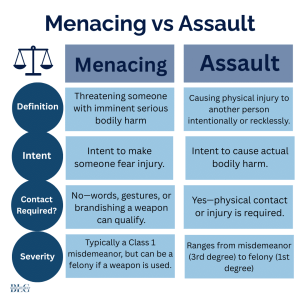
- Misdemeanor menacing (no weapon used) can carry up to 364 days in jail and fines up to $1,000.
- Felony menacing (involving a weapon) is punishable by 1 to 3 years in prison and fines up to $100,000.
- Third-degree assault can lead to up to 18 months in jail and fines of $1,000.
- Second-degree assault is a Class 4 felony with potential imprisonment of 2 to 6 years.
- First-degree assault carries the harshest penalties, with 10 to 32 years in prison.
Even a misdemeanor conviction can have lasting effects, including loss of gun ownership rights, probation, and barriers to employment. These penalties highlight why distinguishing menacing vs assault matters for your defense strategy.
Everyday Situations Leading to These Charges
Law enforcement in Colorado Springs often files menacing or assault charges after domestic disputes, bar fights, road rage incidents, or altercations involving threats with weapons. Because emotions run high, police may arrest first and sort out the details later. That means even if you never intended harm, your words or gestures could still be interpreted as menacing.
Self-defense, mistaken identity, and false allegations are frequent defenses in these cases. At Baker Law Group, PLLC, our attorneys examine every detail—from witness statements to surveillance footage—to challenge assumptions and uncover the truth.
Building a Strong Defense Against Menacing or Assault Charges
A strong defense begins with a clear understanding of intent, evidence, and credibility. For example, your attorney may argue that your actions or words did not create a reasonable fear, or that the alleged victim misinterpreted the situation. For assault, the focus might be on whether injury occurred, whether force was justified, or whether law enforcement violated your rights during arrest.
Baker Law Group, PLLC , approaches each case with precision and focus. Our Colorado Springs criminal defense team includes experienced trial attorneys who understand how prosecutors build their cases. We work to reduce charges, negotiate favorable outcomes, or fight for complete dismissal when possible.
Why Choose Baker Law Group, PLLC
Facing a charge involving menacing vs assault is stressful and personal. Baker Law Group, PLLC, provides the legal strength and clear communication you need during uncertain times. Clients trust our team for:
- Direct access to experienced defense attorneys
- Strategic, evidence-based case preparation
- Aggressive advocacy in court and negotiations
- Compassionate guidance throughout the process
We know that your reputation, freedom, and future are on the line—and we take that seriously.
Call a Colorado Springs Defense Attorney Today
If you’ve been charged with menacing or assault, don’t face it alone. The sooner you speak with a qualified Colorado Springs defense lawyer, the better your chances of protecting your rights and your record. Baker Law Group, PLLC, offers confidential consultations to review your situation and outline the best path forward.
Call our Colorado Springs office today to schedule your consultation and get the strong defense you deserve.