An earnest money agreement plays a crucial role in real estate transactions in Colorado. Earnest money serves as a good-faith deposit, demonstrating a buyer’s serious intent to purchase a property. However, disputes over earnest money can arise, so understanding how these agreements work under Colorado law is essential.
What Is Earnest Money?
Earnest money is a deposit a homebuyer makes to show commitment to purchasing a property. It is typically held in an escrow account by a neutral third party, such as a title company or a real estate brokerage, until closing. If the transaction proceeds smoothly, the earnest money is usually applied toward the buyer’s down payment or closing costs.
However, if the deal fails, the fate of the earnest money depends on the terms outlined in the Colorado Real Estate Commission-approved contract and applicable state laws.
Earnest Money and Colorado Law
In Colorado, real estate transactions involving earnest money must comply with Colorado Revised Statutes (C.R.S.) Title 12, Article 10 governs real estate brokers and escrow accounts. Here are some key aspects of earnest money agreements in Colorado:
- Contractual Obligation: Earnest money agreements are legally binding. The terms regarding earnest money deposits, refund conditions, and forfeiture must be explicitly stated in the purchase contract.
- Escrow Handling: The party holding the earnest money (typically a real estate brokerage or title company) must follow Colorado laws regarding escrow accounts and proper fund handling.
- Dispute Resolution: If a dispute arises over earnest money release, the escrow agent cannot release the funds without mutual agreement from both buyer and seller or a court order.
How Much Earnest Money Is Required in Colorado?
There is no state-mandated minimum or maximum earnest money amount in Colorado. The deposit amount is typically negotiated between the buyer and seller, with most buyers putting down 1% to 3% of the purchase price. However, buyers may offer higher earnest money deposits in competitive markets to make their offers more appealing.
Common Contingencies That Affect Earnest Money Refunds
Colorado real estate contracts often include contingencies determining whether buyers can reclaim their earnest money if the sale does not close. Some of the most common contingencies include:
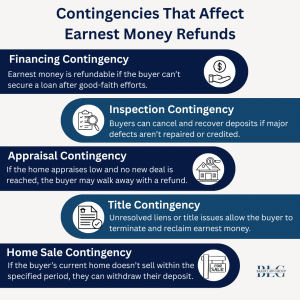 1. Financing Contingency
If a buyer cannot secure financing despite making a good-faith effort, they may be entitled to a full refund of their earnest money.
2. Inspection Contingency
Buyers typically have the right to conduct a home inspection. If significant defects are discovered and the seller refuses to make necessary repairs or offer concessions, the buyer can terminate the contract and recover their deposit.
3. Appraisal Contingency
Suppose a property appraises for less than the agreed-upon purchase price and the buyer and seller cannot renegotiate terms. In that case, the buyer may walk away without forfeiting their earnest money.
4. Title Contingency
A title search ensures the property has no outstanding liens or claims. If title issues arise and the seller cannot resolve them, the buyer may be able to terminate the contract and reclaim their deposit.
5. Home Sale Contingency
Some contracts include a condition that allows a buyer to sell their current home before closing on the new property. If the buyer cannot do so within the agreed timeframe, they may be entitled to a refund of their earnest money.
What Happens to Earnest Money If a Buyer Backs Out?
Suppose a buyer withdraws from the contract for a reason not covered by a contingency. In that case, the seller may be entitled to retain the earnest money as compensation for taking the property off the market. However, if the buyer terminates the contract within the legally permissible timeframe under a valid contingency, they can typically recover their deposit.
How to Protect Your Earnest Money in Colorado
To minimize the risk of losing earnest money, buyers should:
- Carefully review the purchase contract: Ensure all contingencies and deadlines are clearly stated.
- Meet all contract deadlines: Missing deadlines could result in forfeiting the deposit.
- Work with an experienced real estate attorney: Legal guidance can help navigate contract terms and protect your interests.
- Document everything: Keep records of communications and actions taken to fulfill contractual obligations.
Resolving Earnest Money Disputes
If a dispute arises over who is entitled to the earnest money, the escrow holder cannot release the funds without written agreement from both parties or a court order. In such cases, options for resolution include:
- Mediation or Arbitration: Many Colorado real estate contracts include a mediation clause requiring parties to attempt resolution before pursuing legal action.
- Litigation: If mediation fails, parties may need to file a lawsuit to determine the earnest money’s rightful owner.
Contact a Denver Real Estate Lawyer
Earnest money agreements are a critical component of Colorado real estate transactions, and disputes over these deposits can become complex. If you are buying or selling property and need legal guidance regarding an earnest money agreement, Baker Law Group can help. Our team provides experienced legal counsel to protect your interests and ensure compliance with Colorado real estate laws.
Contact Baker Law Group today to schedule a consultation with a Denver real estate lawyer and safeguard your investment.