Homeownership offers a sense of freedom, but for residents in communities governed by a Homeowners Association (HOA), that freedom often comes with certain restrictions. HOAs can impose rules on everything from landscaping choices to major home improvements. If your HOA denies your request for a home improvement project, it can feel frustrating and limiting. However, understanding the reasons behind the denial and the steps you can take to challenge or resolve the situation can empower you to move forward.
For homeowners in Colorado, where HOAs are common in residential developments, navigating disputes with your HOA requires a thoughtful and informed approach. Here’s what you need to know about handling a denied home improvement request.
Understand the HOA’s Authority and Governing Documents
The first step in addressing a denial is to review your HOA’s governing documents, which may include the Covenants, Conditions, and Restrictions (CC&Rs), bylaws, and architectural guidelines. These documents outline the rules and standards that homeowners must follow and the process for submitting improvement requests.
HOAs typically have an architectural review committee that evaluates requests to ensure projects align with the community’s aesthetic and property values. If your request doesn’t comply with these standards, the HOA may deny it. For example, Colorado HOAs may reject projects involving non-approved paint colors, fence designs, or structures obstructing views.
Common Reasons for HOA Denials
Understanding why your request was denied can help you craft a plan to address the issue. Common reasons for denial include:
- Noncompliance with HOA guidelines: Your project will likely be rejected if it violates specific provisions in the CC&Rs, such as height restrictions or prohibited materials.
- Incomplete application: HOAs require detailed plans, permits, and descriptions of proposed projects. Missing documents or incomplete applications can lead to denial.
- Impact on neighbors or common areas: Projects that affect neighbors’ privacy, views, or shared spaces may face rejection.
Once you know the exact reason for the denial, you can assess whether there is room for negotiation or appeal.
Steps to Take After an HOA Denial
If your home improvement request is denied, there are several steps you can take to resolve the issue effectively:
1. Review the Denial Letter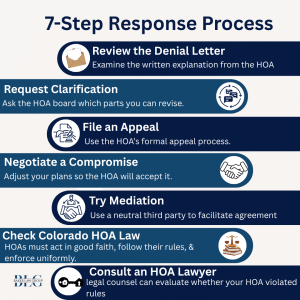
Your HOA should provide a written explanation for the denial. Carefully read this letter to identify the reasons for the rejection and any references to HOA rules.
2. Request Clarification or Feedback
If the denial is unclear, consider contacting the HOA board or the architectural review committee for clarification. This is an opportunity to ask for suggestions or modifications that make the project more acceptable.
3. Appeal the Decision
Many HOAs have an appeal process outlined in their governing documents. This process often involves presenting your case to the HOA board during a hearing. Prepare a detailed explanation of why your project complies with the CC&Rs and why it benefits the community. Providing photographs, blueprints, and support from neighbors can strengthen your appeal.
4. Negotiate a Compromise
In some cases, you may be able to negotiate adjustments to your project to address the HOA’s concerns. For example, changing a new deck’s color or altering a fence’s height could lead to approval.
5. Seek Mediation
Colorado law encourages alternative dispute resolution for HOA conflicts. Mediation can be a productive way to resolve disputes without escalating to litigation. A neutral third party can help you and the HOA reach an agreement that satisfies both parties.
6. Consult Colorado Laws on HOAs
Colorado has specific laws governing HOAs, including the Colorado Common Interest Ownership Act (CCIOA). This law requires HOAs to act in good faith and follow their governing documents. If you believe your HOA acted improperly, such as enforcing rules inconsistently, you may have grounds for legal action.
7. Consider Hiring a Denver HOA Lawyer
If all other options fail, consulting a Denver HOA lawyer is essential. A lawyer can evaluate whether the HOA violated state laws or its governing documents and can represent you in negotiations or court.
Know Your Rights Under Colorado HOA Laws
Colorado homeowners have legal protections under the CCIOA. This law requires HOAs to:
- Act reasonably and in good faith when enforcing rules.
- Provide homeowners with notice and an opportunity to be heard during disputes.
- Ensure rules are enforced uniformly across the community.
If your HOA does not adhere to these requirements, you may have legal recourse. Colorado law also allows homeowners to request HOA records and financial documents to ensure transparency.
Proactive Tips for Working with Your HOA
To avoid denials or disputes in the first place, consider these tips:
- Understand the rules: Familiarize yourself with your HOA’s CC&Rs and architectural guidelines before planning any improvements.
- Communicate early: Contact the HOA or the architectural review committee for informal feedback during the planning phase.
- Submit a complete application: To avoid delays, include all required documents, plans, and permits in your application.
Being proactive and collaborative can help you navigate the approval process more smoothly.
Contact a Denver HOA Lawyer
It may be time to consult a legal professional if you’ve exhausted your options and the HOA remains unreasonable in its denial. Baker Law Group has extensive experience helping Colorado homeowners resolve disputes with their HOAs. Whether through mediation, negotiation, or litigation, our team protects your rights and advocates for your interests.
Contact us today to learn more about how Baker Law Group can assist with your HOA concerns. We’re committed to finding practical solutions so you can move forward with your home improvement projects.
Call Baker Law Group to schedule a consultation with a Denver HOA lawyer.