
Earnest Money in Colorado: What Buyers and Sellers Need to Know
Earnest money is a good-faith deposit a buyer makes when entering a real estate purchase agreement. It signals serious intent to purchase and protects the seller if the buyer backs out without a valid reason. Baker Law Group, PLLC helps buyers and sellers in Colorado understand their rights under earnest money agreements before disputes arise.
Key Takeaways
- Earnest money shows a buyer’s good-faith intent to purchase, but Colorado law does not require it for a contract to be valid.
- Colorado sets no minimum or maximum earnest money amount, and buyers typically offer one to three percent of the purchase price.
- A financing, inspection, appraisal, title, or home sale contingency can let a buyer recover their deposit, but each carries its own strict deadline.
- If a buyer backs out without a valid contingency, Colorado treats it as a default and the seller may keep the deposit as liquidated damages.
- The escrow holder cannot release earnest money without written authorization from both parties or a court order, even when one side disputes the outcome.
- New construction contracts often carry larger deposits and fewer contingency protections, so a real estate attorney should review the contract before signing.
What Is Earnest Money?
Earnest money is a deposit made by a homebuyer to show commitment to purchasing a property. It is typically held in an escrow account by a neutral third party. That third party is usually a title company or real estate brokerage. When the transaction closes successfully, the earnest money applies toward the buyer’s down payment or closing costs.
Earnest money is not the same as a down payment. The down payment is paid at closing and represents the buyer’s equity in the property. Earnest money is a deposit made at the time of contract to secure the buyer’s intent. Whether the buyer gets that deposit back if the deal falls through depends on the contract terms and applicable Colorado law.
Is Earnest Money Required for a Valid Contract in Colorado?
No. Earnest money is not legally required to make a real estate contract valid in Colorado. A contract can be enforceable without it. However, the other essential elements must exist: mutual agreement, consideration, and legal capacity.
Sellers typically expect earnest money in residential transactions. It serves as a financial commitment that discourages buyers from walking away without consequence. Without earnest money in place, a seller has limited financial recourse if a buyer backs out of a signed agreement.
How Much Earnest Money Is Required in Colorado?
Colorado sets no state-mandated minimum or maximum earnest money amount. Buyer and seller negotiate the deposit amount directly. Most buyers put down between one and three percent of the purchase price. In competitive markets, buyers often offer higher deposits to make their offers more appealing to sellers.
Both parties should discuss and agree on the amount before signing the purchase contract. Once both parties sign, the agreed earnest money amount becomes part of the binding agreement.
What Happens After Earnest Money Is Deposited?
Once the buyer dispenses the earnest money, the funds go into an escrow account held by a neutral third party. That party, typically a title company or real estate brokerage, holds the funds until the transaction closes or terminates.
The escrow holder cannot release the funds without mutual written agreement from both the buyer and the seller. Alternatively, a court order can authorize release. When the transaction closes, the funds apply toward the buyer’s costs at closing. If the transaction falls through, the release process depends on the contract terms and the reason for termination.
What Happens If a Buyer Does Not Deposit Earnest Money?
If a buyer fails to deposit the agreed earnest money within the contract deadline, the seller may have grounds to terminate the contract. In Colorado, the Colorado Real Estate Commission-approved contract sets a specific deadline for earnest money deposit.
When a buyer fails to deposit the agreed earnest money amount, the seller may have the right to terminate the contract. For that reason, buyers should treat the earnest money deadline with the same urgency as any other contract deadline.
Common Contingencies That Affect Earnest Money Refunds
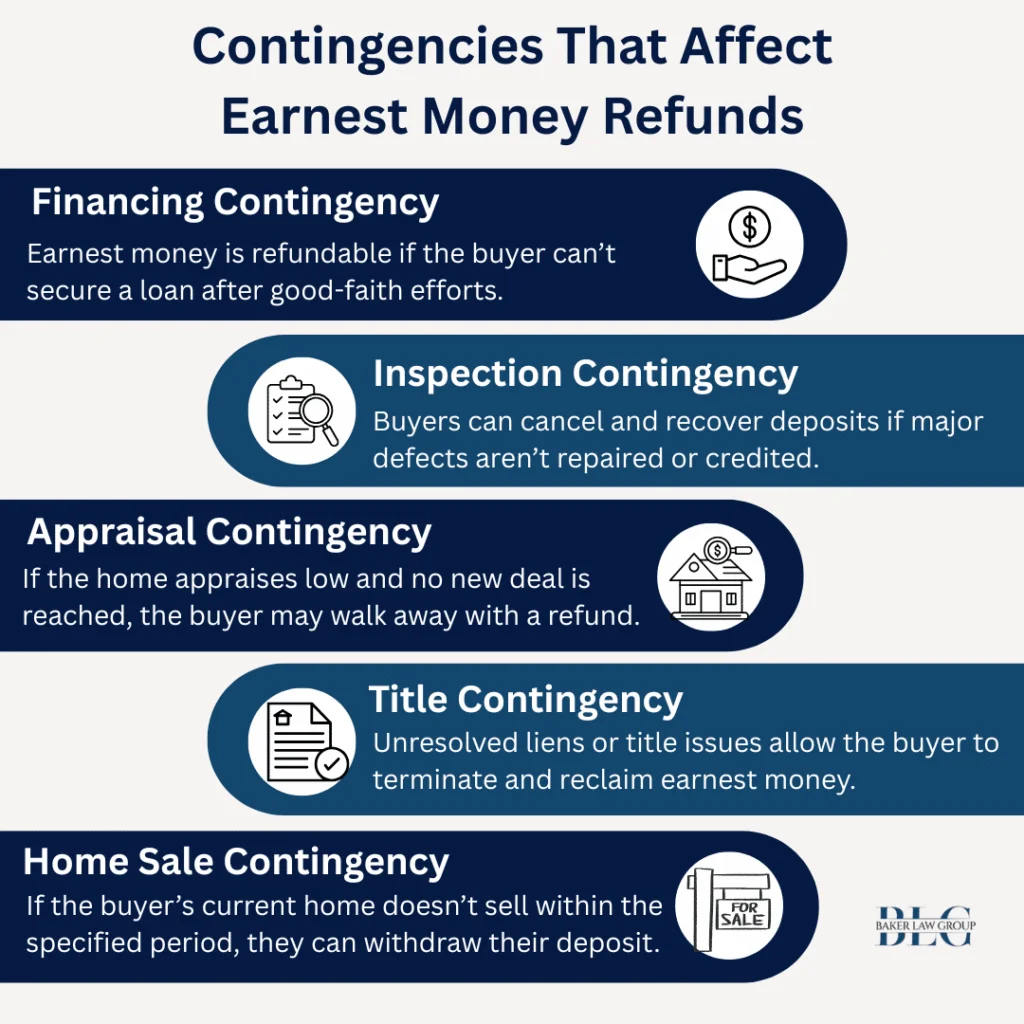
Colorado real estate contracts commonly include contingencies that protect a buyer’s ability to recover their earnest money if the transaction does not close. Each contingency carries its own deadline. Missing a contingency deadline can cost a buyer their deposit even if the contingency would otherwise apply.
A financing contingency allows a buyer to recover their deposit if they are unable to secure a loan despite making a good-faith effort.
An inspection contingency gives the buyer the right to terminate the contract if significant defects surface and the seller refuses to address them.
Appraisal contingencies allow a buyer to exit without penalty if the property appraises below the agreed purchase price and the parties cannot renegotiate terms.
A title contingency protects buyers when title issues arise that the seller cannot resolve, such as outstanding liens or ownership disputes.
Home sale contingencies allow a buyer to cancel if they cannot sell their existing home within the agreed timeframe. Each of these contingencies must be invoked correctly and within the specified deadline to protect the buyer’s deposit.
When Can a Seller Keep the Earnest Money?
A seller may keep the earnest money if a buyer terminates the contract for a reason not covered by a valid contingency. In Colorado, this qualifies as a buyer default. The earnest money then serves as liquidated damages for the seller’s losses.
However, the seller is not automatically entitled to the funds. The escrow holder must receive written authorization from both parties or a court order before releasing the deposit. If the buyer disputes the seller’s claim, the funds remain in escrow until the parties reach written agreement or a court resolves the dispute.
A default claim doesn’t mean you’ve automatically lost your earnest money.
If a seller says you defaulted, the funds don’t just disappear. They stay frozen in escrow until both sides agree in writing or a court decides. Baker Law Group, PLLC can review your contract and explain where you actually stand.
Earnest Money on New Construction in Colorado
New construction contracts often include earnest money terms that differ from standard resale transactions. Builders frequently require larger deposits and may limit or eliminate contingency protections. For example, many builder contracts restrict a buyer’s ability to back out based on inspection results because the buyer agreed to purchase before construction was complete.
Whether earnest money is refundable on a new construction purchase depends entirely on the specific contract. Some builders use custom contracts rather than the Colorado Real Estate Commission standard form. Those custom contracts may include terms that are less favorable to the buyer. For that reason, having a real estate attorney review any new construction contract before signing is particularly important.
How to Resolve an Earnest Money Dispute in Colorado
When buyer and seller disagree about who is entitled to the earnest money, the escrow holder cannot act without written authorization from both parties or a court order. The funds stay frozen until both parties resolve the dispute.
Most Colorado real estate contracts include a mediation clause. That clause requires the parties to attempt mediation before pursuing litigation. Mediation involves a neutral third party who helps both sides reach a written agreement. When mediation succeeds, the escrow holder receives written authorization to release the funds accordingly. If mediation fails, the parties may proceed to arbitration or litigation.
A court can determine who is legally entitled to the deposit. Disputes that reach litigation are often more costly than the deposit itself, which is why early legal guidance can prevent escalation.
Have More Questions? We Have Answers.
Earnest money is refundable in Colorado when a buyer terminates the contract under a valid contingency and within the required deadline. Common refundable situations include failed financing, significant inspection findings, an appraisal below the purchase price, unresolved title issues, or an inability to sell the buyer’s current home. If a buyer terminates without a valid contingency, the seller may be entitled to keep the deposit. The specific terms of the purchase contract govern every situation.
Yes. The earnest money amount is negotiable in Colorado. Buyer and seller agree on the deposit during contract negotiations. A buyer may offer a higher amount to strengthen their offer in a competitive market. A seller may request a larger deposit as a condition of accepting an offer. Once the signed contract includes the agreed amount, it becomes a binding obligation for both parties.
When a real estate transaction terminates, the escrow holder requires a signed release form before disbursing the earnest money deposit. In Colorado, this form authorizes the title company or brokerage to transfer the funds to the designated party. Both the buyer and the seller must sign the form before any release occurs. If one party refuses to sign, the funds remain in escrow. The refusing party may face legal consequences for unreasonably withholding authorization, and the other party may pursue mediation or litigation to force the release.
Earnest money held in an escrow account may or may not earn interest depending on the type of account used and the terms of the contract. Most short-term real estate transactions use standard escrow accounts that do not generate meaningful interest. Some contracts specify how any interest earned will be distributed. If this is a concern, it should be addressed explicitly in the purchase agreement before signing.
A seller can back out of a contract under certain limited circumstances, but Colorado law does not allow a seller to keep the earnest money simply for doing so. If a seller terminates without a valid legal basis, the buyer is typically entitled to a full refund of their earnest money. The buyer may also have grounds to pursue additional damages. Sellers who wish to exit a signed contract should consult a real estate attorney before taking any action. Backing out without legal justification can expose a seller to breach of contract liability.
Colorado law does not set a specific number of days for earnest money to be returned after a failed transaction. The timeline depends on the contract terms and the cooperation of both parties. If the buyer has a valid right to a refund under a contingency, both parties should sign a mutual release form promptly. Delays in signing can hold funds in escrow indefinitely. If a seller unreasonably withholds their signature on a release, the buyer may need to pursue mediation or legal action to recover the deposit.
Talk to a Denver Real Estate Lawyer Today
A misunderstood contract term or a missed deadline can cost a buyer their deposit or leave a seller without recourse. Getting legal guidance before a dispute arises is far less costly than resolving one after the fact.
Baker Law Group, PLLC works with buyers and sellers across Colorado on earnest money agreements, contract disputes, and real estate transaction support. Contact Baker Law Group, PLLC today to schedule a consultation with a Denver real estate lawyer.

Reviewed by Attorney Tyler Gurnee
Member & Practice Leader of Litigation
Tyler leads Baker Law Group, PLLC’s litigation team, focusing on real estate disputes, breach of contract actions, landlord-tenant conflicts, and foreclosures. He’s represented clients across Colorado and Nevada, has a wealth of trial experience, and has obtained millions of dollars in judgments for his clients over the past decade. Tyler has also served on the Colorado Creditor Bar Association board of directors, lectured attorneys on foreclosure law, and submitted briefings in the Supreme Court of the United States.
Click here to know more about Tyler Gurnee.