
Can You Refuse to Pay a Contractor for Poor Work in Colorado?
Yes. In Colorado, you can refuse to pay a contractor for poor work, but only when the refusal is legally justified and documented. Withholding payment without a valid legal basis exposes you to breach of contract claims, mechanics liens, and potential liability for the full contract amount plus attorney fees. Baker Law Group, PLLC helps property owners and businesses across Colorado understand exactly when withholding payment is defensible, what steps to take before refusing to pay, and how to protect themselves when a contractor dispute escalates.
This page explains your rights when a contractor delivers poor work, what legal remedies are available, whether a contractor can be criminally charged, and how to fire a contractor and sue when the situation demands it.
Key Takeaways
- Withholding payment is legally justified only when a contractor’s work amounts to a material breach, not a minor or cosmetic defect.
- Before refusing to pay, document defects in writing, send formal notice, and get an independent repair estimate to protect your legal position.
- A contractor who isn’t paid can file a mechanics lien, which can cloud your property’s title and block a sale or refinance.
- Whether suing a contractor is worth it depends on the dispute amount, your documentation, the contractor’s ability to pay, and the statute of limitations.
- Most contractor disputes are civil matters, but a contractor can face criminal charges for fraud, theft, or taking payment with no intent to perform.
- Even without a written contract, you can terminate a contractor, but you still owe fair value for any work that was properly completed.
When You Can Legally Refuse to Pay a Contractor
Withholding payment from a contractor is legally justified in Colorado when the contractor has materially breached the contract. A material breach means the contractor failed to perform in a way that goes to the core of what was agreed upon, not a minor or trivial deficiency.
Situations that typically justify withholding payment include:
- Work that does not meet the specifications in the written contract
- Work that violates Colorado building codes or applicable construction standards
- Incomplete work where the contractor abandoned the project
- Work that requires significant remediation or replacement to be usable
- Defects that pose a safety risk to occupants or the structure
Situations that generally do not justify withholding full payment include minor cosmetic imperfections, disagreements about finishes that were not clearly specified, or normal construction variations that do not affect function or safety. In those cases, you may have grounds to seek a price reduction or repair, but withholding all payment is harder to defend.
The distinction between a material breach and a minor deficiency is not always obvious. A Colorado construction defect lawyer at Baker Law Group, PLLC can assess the specific facts of your situation and tell you whether your grounds for withholding payment are legally defensible before you make that decision.
What to Do Before You Refuse to Pay
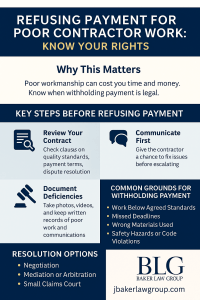
Refusing to pay without documentation creates serious legal exposure. Before withholding any payment, take these steps to build and preserve your legal position.
Document the defects in writing. Photograph every defect, date the photographs, and create a written record of what was agreed to versus what was delivered. If you have a written contract, compare the deliverables specified against what the contractor actually provided. If no written contract exists, document your communications, emails, text messages, and any verbal agreements you can reconstruct.
Send a formal written notice. Before withholding payment, notify the contractor in writing of the specific deficiencies and give them a reasonable opportunity to cure the defects. Colorado courts look unfavorably on property owners who withhold payment without first giving the contractor a chance to fix the problem. The notice should identify each defect specifically and set a reasonable deadline for correction.
Get an independent assessment. Obtain a written estimate from another licensed contractor documenting the cost to repair or complete the work. This estimate becomes critical evidence if the dispute goes to court or arbitration. It establishes the actual damages you suffered and counters any claim by the original contractor that their work was acceptable.
Stop making additional payments. If you have already made partial payments and the work is deficient, stop making further payments while you document the issues. Do not wait until the project is complete to raise defects you identified early. Continuing to pay while complaining about the work weakens your legal position.
For Colorado Springs property owners dealing with a contractor dispute, a Colorado Springs construction lawyer at Baker Law Group can advise on the specific steps to take before withholding payment to protect your legal position from day one.
What a Contractor Can Do When You Refuse to Pay
Understanding the contractor’s legal options is critical before you withhold payment. A contractor in Colorado who believes they are wrongfully denied payment has several tools available.
Mechanics lien. The most significant risk property owners face when withholding payment is a mechanics lien. Under the Colorado mechanics lien statute, a contractor, subcontractor, or supplier who is not paid for work or materials can file a lien against the property. A mechanics lien clouds the title and can prevent the property from being sold or refinanced until the lien is resolved. Colorado imposes strict deadlines on mechanics lien filings, and contractors who miss those deadlines lose the right to file. Understanding those deadlines helps you assess how much time you have to resolve the dispute before the lien risk becomes immediate. Protecting your payment rights as a contractor explains how mechanics liens work from the contractor’s perspective, which is useful context for any property owner facing this threat.
Breach of contract lawsuit. A contractor can sue for the unpaid contract balance. If they prevail, they may recover the amount owed plus interest and, in some cases, attorney fees depending on the contract terms. This is why documenting the defects and having an independent assessment is essential before refusing to pay.
Collections action. A contractor may also pursue collection through debt collection channels, which can affect your credit and create additional complications even if the underlying dispute is on your side.
A lien on your property doesn’t mean you’re stuck with it.
A mechanics lien can cloud your title and hold up a sale or refinance, but strict filing deadlines apply and liens can be challenged or resolved. Baker Law Group, PLLC can help you deal with a lien or protect against one before it’s filed.
How to Fire a Contractor Without a Contract
Firing a contractor is more straightforward when you have a written contract with termination provisions. When no written contract exists, the process is riskier and requires more careful handling.
Without a written contract, the agreement is governed by oral contract principles under Colorado law. You still have the right to terminate a contractor who is delivering unacceptable work, but the absence of written terms makes every aspect of the dispute harder to prove. Follow these steps:
First, stop work in writing. Send the contractor a written notice, by email or certified letter, stating that you are terminating the engagement effective immediately and the specific reasons for the termination. Be factual and specific. Avoid language that could be construed as an admission that the work was acceptable up to that point.
Second, document the state of the work at the time of termination. Photograph everything before the contractor removes any materials or equipment from the site.
Third, secure the property. Once you have terminated the contractor, take steps to prevent them from returning to the site without your permission. Change access codes or locks if necessary.
Fourth, calculate what you have already paid versus what work was actually completed. This calculation determines your damages if the dispute proceeds to court. You are entitled to recover payments made for work that was not performed or was performed defectively, but you owe fair value for work that was properly completed even without a written contract.
If you are in this situation, what to do if a contractor damages your property in Colorado covers the specific steps to take when a contractor leaves damage behind after termination.
Is It Worth Suing a Contractor in Colorado?
Whether suing a contractor is worth it depends on four factors: the amount in dispute, the strength of your documentation, the contractor’s ability to pay a judgment, and the applicable statute of limitations.
Amount in dispute. For disputes under a certain threshold, Colorado small claims court is a faster and less expensive option than district court. Above that amount, a district court filing is required. Attorney fees and litigation costs become a significant factor for mid-range disputes where the recovery may not justify the expense of full litigation.
Strength of your documentation. A contractor dispute without strong documentation is a difficult case to win. If you have a written contract, photographs of the defects, a written notice giving the contractor a chance to cure, and an independent estimate of repair costs, your case is substantially stronger than if you are relying on memory and verbal agreements.
The contractor’s ability to pay. A judgment against a contractor who has no assets or is out of business is worth very little in practical terms. Before investing in litigation, consider whether the contractor has the financial resources to satisfy a judgment. A licensed contractor with insurance and ongoing operations is a much better litigation target than a sole proprietor who has dissolved their business.
The statute of limitations. Colorado sets time limits on how long you have to bring a construction-related claim. Missing that deadline means losing your right to sue regardless of how strong your case is. How long a contractor is liable for work in Colorado explains the applicable deadlines in detail.
For disputes that justify litigation, a Denver construction lawyer at Baker Law Group can assess your case, calculate your likely recovery, and give you a direct recommendation on whether litigation makes financial sense for your specific situation.
How to Sue a Contractor in Colorado
Suing a contractor in Colorado follows the standard civil litigation process with some construction-specific considerations.
Step 1: Send a formal demand letter. Before filing suit, send the contractor a written demand for specific relief, whether that is repair of the defective work, return of payments, or compensation for the cost of remediation by a different contractor. Many disputes resolve at this stage, particularly when the contractor receives a well-documented demand from an attorney.
Step 2: File the complaint. If the demand does not produce a resolution, file a complaint in the appropriate Colorado court. The filing goes in the district court in the county where the property is located or where the contract was to be performed.
Step 3: Serve the contractor. The contractor must be properly served with the complaint and summons. Proper service is a procedural requirement that, if done incorrectly, can delay or undermine the case.
Step 4: Conduct discovery. Both sides exchange documents, take depositions, and gather evidence. This is where your pre-dispute documentation becomes most valuable. Contracts, photographs, written notices, independent estimates, and communications all become part of the evidentiary record.
Step 5: Resolve or try the case. Most construction disputes settle before trial once both sides have seen the evidence. If settlement is not possible, the case proceeds to trial where a judge or jury determines liability and damages.
What constitutes contractor negligence under Colorado construction law explains the legal standard courts apply when evaluating whether a contractor’s work fell below the required standard of care, which is a key question in any contractor lawsuit.
Can a Contractor Be Criminally Charged in Colorado?
Most contractor disputes are civil matters, not criminal ones. However, certain contractor conduct does cross into criminal territory under Colorado law. A contractor can face criminal charges when their conduct involves fraud, theft, or intentional deception rather than merely poor workmanship.
Specific situations where criminal charges may apply include:
- Taking a deposit or advance payment and never beginning the work
- Deliberately misrepresenting the scope of work or materials used
- Using funds paid for one project to pay obligations on another without disclosure
- Abandoning a project after receiving payment with no intent to return
- Performing unlicensed work in a trade that requires licensing in Colorado
The distinction between a civil breach of contract and criminal conduct is intent. A contractor who tries to complete the work but does it poorly is typically a civil matter. A contractor who takes money with no intent to perform, or who deliberately deceives you about what you are getting, may face criminal exposure.
Whether a contractor can go to jail for not finishing a job in Colorado covers the criminal liability question in detail, including the specific statutes that apply and what conduct crosses the line from civil to criminal.
For construction disputes in Fort Collins and Larimer County, a Fort Collins construction lawyer at Baker Law Group handles both civil litigation and contractor disputes throughout Northern Colorado.
Do Not Pay for Work You Did Not Get. We Will Help You Fight Back.
A contractor who delivers poor work and expects full payment is betting that you will not take action. Baker Law Group, PLLC helps property owners and businesses across Colorado hold contractors accountable, whether that means withholding payment defensibly, filing a lawsuit, or responding to a mechanics lien.
Baker Law Group, PLLC handles contractor disputes, construction defect claims, breach of contract litigation, and mechanics lien defense across Colorado. Our attorneys give you a direct assessment of your legal position and a clear plan for protecting your property and your money.
Contact Baker Law Group, PLLC today to schedule a consultation with a Colorado construction lawyer and find out exactly what your rights are when a contractor does not deliver what they promised.