
How Long Does Probate Take in Texas?
In Texas, probate typically takes between six months and one year for most estates. That timeline can run shorter for simple, uncontested estates and considerably longer when disputes, creditor claims, or complex assets are involved. Baker Law Group, PLLC helps families across Texas move through the probate process as efficiently as the law allows, without unnecessary delays and without the confusion that comes from not knowing what to expect next.
If you are not yet familiar with what probate involves, our guide on what probate is in Texas covers the full process in detail.
What Affects How Long Probate Takes in Texas
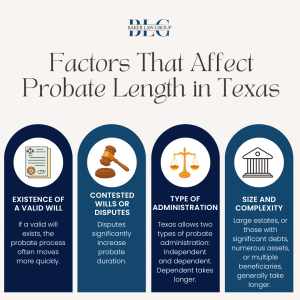
No two estates move at exactly the same pace. Several factors directly control how long your probate case will take.
Whether a valid will exists. Probate with a valid will in Texas moves faster than probate without one. When a will is in place, the court has clear instructions on who receives what. Without a will, the court must identify heirs and distribute property under Texas intestacy law, which adds time and complexity to every stage.
The type of administration. Texas allows two forms of probate administration: independent and dependent. Independent administration requires far less court involvement. The executor manages the estate with minimal court oversight, which reduces both time and cost. Dependent administration requires court approval at each stage, which slows the process significantly. Most Texas wills authorize independent administration, and all beneficiaries can agree to it even when the will does not specify it, provided the court approves.
Whether the will is contested. A contested will stops the standard probate timeline entirely. When beneficiaries dispute the validity of a will or disagree on asset distribution, Texas courts must resolve those disputes before the estate moves forward. Contested cases can extend probate from months to years depending on the complexity of the dispute.
The size and composition of the estate. Estates with multiple properties, business interests, investment accounts, or significant debts take longer to inventory, appraise, and settle. Creditor claims add another layer, since Texas law gives creditors specific deadlines to file against the estate and executors must verify and resolve each valid claim before distributing assets.
Court caseload by county. Probate courts in Harris County, Travis County, and Bexar County each carry different caseloads and scheduling timelines. Local knowledge of how each court operates makes a measurable difference in how efficiently your case moves.
How Long Does Probate Take in Texas With a Will
When a valid will exists and no one contests it, Texas probate generally completes within six months to one year. Here is how that timeline typically breaks down:
Filing and initiation: one to two months. The process starts when someone files an application with the appropriate Texas probate court. Scheduling depends on each county court’s docket and caseload, so the initial hearing may be set within a few weeks in some counties and closer to two months in others. At that hearing, a judge confirms the will’s validity and appoints the executor named in the will.
Inventory and creditor notification: one to three months. After appointment, the executor notifies creditors and beneficiaries, then inventories and appraises the estate’s assets. Texas Estates Code § 309.051 gives executors 90 days to file the inventory with the court, though extensions are available in some circumstances.
Debt settlement: three to six months. Texas law gives creditors a specific window to file claims against the estate. Generally, creditors have four months to file, though the exact deadline depends on when and how each creditor received notice, since the clock starts differently for secured creditors versus general creditors who received direct notice. The executor then reviews, verifies, and pays valid debts from estate funds. Disputes over creditor claims can extend this stage.
Asset distribution: one to four months. Once debts and any applicable taxes are settled, the executor distributes remaining assets to beneficiaries according to the will. Straightforward distributions conclude quickly. Estates involving real property transfers or multiple beneficiaries take longer.
Closing the estate: one month. The executor files a final accounting with the probate court. The court reviews it and formally closes the estate.
For families in Austin, an Austin probate lawyer at Baker Law Group, PLLC can guide the executor through each of these stages and make sure nothing delays the filing deadlines that control your timeline.
How Long Does Probate Take in Texas Without a Will
Probate without a will, called intestate probate, takes longer than probate with a valid will. Without written instructions from the deceased, the court must determine who the legal heirs are and distribute property according to Texas intestacy law. That process adds steps that do not exist in a standard testate probate.
The court may require a proceeding to declare heirship under Texas Estates Code Chapter 202, which involves presenting evidence to establish the family relationships and legal heirs of the deceased. This adds weeks or months before the estate can move forward. Additionally, without a will authorizing independent administration and without agreement among all beneficiaries, intestate estates default to dependent administration. That means more court involvement at every stage compared to the independent administration most will authorize.
For intestate estates in San Antonio, our San Antonio probate lawyer team handles heirship proceedings and dependent administration cases regularly and can tell you upfront what timeline to expect based on your specific situation.
How to Shorten the Probate Timeline in Texas
Some factors that slow probate are unavoidable. Others are within your control. These steps consistently produce faster outcomes.
File promptly. Texas Estates Code § 256.003 requires that a will be filed for probate within four years of the date of death. Waiting unnecessarily compresses your timeline and limits your options. Filing as soon as you are ready keeps every subsequent deadline on track.
Choose independent administration when available. If the will authorizes it, or if all beneficiaries agree, independent administration removes the need for court approval at each stage. That single decision often cuts months from the total timeline.
Keep beneficiaries informed. Disputes among heirs are one of the most common causes of probate delay. Proactive, transparent communication about what the estate contains and how it will be distributed reduces the risk of contested claims arising later in the process.
Respond to court deadlines immediately. Missed inventory deadlines, late creditor responses, and delayed filings all extend your case. Executors who treat every deadline as firm move cases to conclusion faster than those who do not.
Work with an attorney who knows your local court. Harris County probate courts operate differently from Travis County courts. An attorney familiar with local procedures, judges, and scheduling practices identifies shortcuts and avoids delays that a generalist would not anticipate.
For families in Houston, our Houston probate lawyer team knows Harris County probate court procedures and can tell you exactly what to expect from filing to close.
What People Get Wrong About Texas Probate
Several common misconceptions cause unnecessary anxiety about the probate timeline.
Probate always takes years. Most Texas probates close within one year. Complex or contested cases take longer, but the idea that probate is always a multi-year ordeal does not reflect how most estates actually move through the Texas court system.
All estates require significant court involvement. Independent administration under Texas Estates Code Chapter 401 gives executors broad authority to manage and close an estate with minimal court oversight. Many estates settle efficiently with little courtroom involvement at all.
Probate is always something to avoid. A Senior Associate Attorney at Baker Law Group, PLLC addresses this directly: “There are some attorneys out there who will fearmonger and tell you that everybody needs a trust to avoid probate. At Baker Law Group, PLLC, our philosophy is that we don’t try to fearmonger everybody into getting a trust. You don’t have to have one. If you plan properly, you can pass all of your assets in a very streamlined way without needing a trust.” Probate is a legal process, not a punishment. For many Texas families, it is a straightforward path to closing an estate cleanly and legally.
Get a Clear Probate Timeline From a Texas Probate Attorney
Knowing how long probate takes in Texas is only half the answer. The other half is knowing what your specific estate will look like and what steps move it forward most efficiently. Baker Law Group, PLLC handles probate cases across Texas, including in Austin, San Antonio, and Houston, and gives families a direct, honest assessment of what their case involves from day one.
Contact Baker Law Group, PLLC today to schedule a consultation with a Texas probate attorney and get a clear picture of your timeline from the start.